















The cheapest DeFi transaction is often not the one with the lowest gas price. It is the transaction that avoids a failed execution, an unnecessary approval, a poorly timed bridge, or an extra network switch. That counterintuitive point matters more than any wallet slogan. A browser wallet such as the Rabby wallet extension can make multi-chain activity easier to inspect and coordinate, but it cannot repeal block-space scarcity, smart-contract risk, or the economic trade-offs built into Ethereum and other EVM networks.
Consider a familiar US-based DeFi scenario. An investor wants to move an asset, approve a decentralized exchange, swap it, and deposit the result into a lending protocol. The interface may make this appear to be one smooth workflow. Underneath, it can involve several signed messages, multiple contracts, different fee markets, and assumptions about token balances. The useful question is therefore not simply whether Rabby is “fast” or “secure.” It is how a multi-chain wallet helps the user understand what is being signed, where gas is being spent, and where the workflow can still fail.
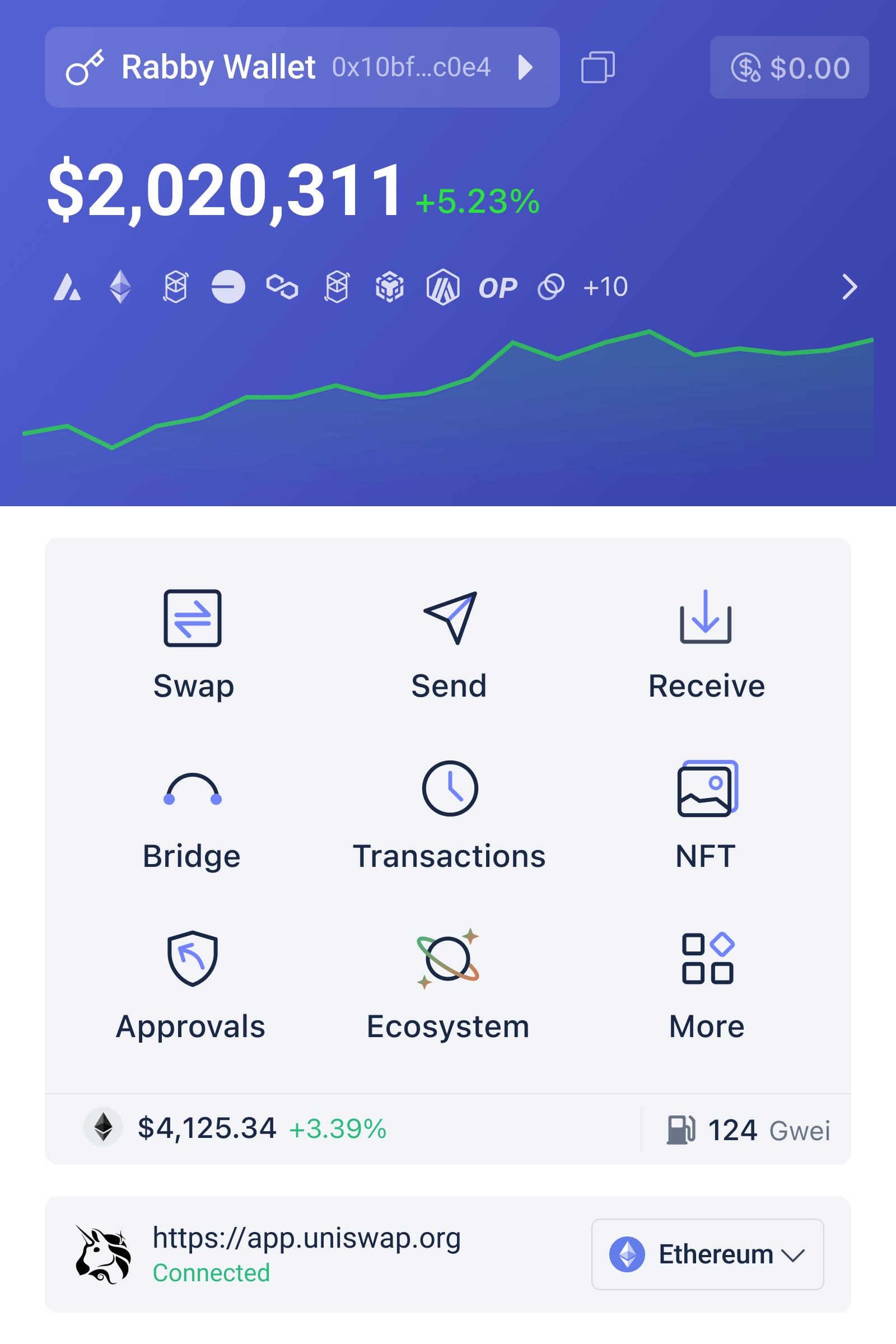
What a multi-chain wallet actually coordinates
A cryptocurrency wallet does not store coins in the same sense that a physical wallet stores cash. On an EVM-compatible network, assets are recorded by smart contracts or by the network’s account state. The wallet extension holds, or provides access to, cryptographic keys and uses those keys to authorize transactions. It also presents balances, network choices, contract requests, and fee estimates through the browser.
That distinction is more than technical wording. If a user changes from Ethereum mainnet to another EVM chain, the assets have not necessarily moved. The user has changed the network context in which the wallet reads balances and submits transactions. A token can exist on several chains as separate contract deployments, while a bridge may create a representation on one chain after locking or burning an asset elsewhere. A multi-chain wallet reduces interface friction, but it does not make liquidity, token standards, or security assumptions identical across networks.
Rabby’s recent project positioning, described during the week of August 24, 2026, emphasizes Ethereum and EVM support across Chrome and Brave. For a DeFi user, the practical implication is a single browser-based control surface for activity that may span several EVM environments. That is useful, particularly when comparing transaction costs or locating a position. It should not be confused with a guarantee that every chain, decentralized application, or bridge carries the same level of reliability.
Before installing any wallet extension, the basic security model deserves attention. The download source should be checked carefully, the publisher and requested permissions should be reviewed, and the recovery phrase should never be entered into a website, support form, or “verification” window. Readers who want to begin with the official installation route can use this rabby wallet download link, then independently confirm that the extension and its permissions match expectations. A wallet can warn about a suspicious request, but it cannot protect a recovery phrase that the user voluntarily exposes.
Why gas optimization is a systems problem
Gas is a measurement of computational work and storage activity, not a fixed surcharge attached to a token swap. The final fee is generally shaped by the amount of gas used and the price paid per unit of gas. On networks using fee markets with a base fee and a user-selected priority component, demand for block space influences the cost. On other EVM chains, the exact fee model and market depth may differ. The same action can therefore have a different dollar cost depending on network conditions, asset prices, and the contract path chosen.
This is where a common misconception breaks down: changing networks is not automatically gas optimization. A cheaper chain may have lower fees but thinner liquidity, greater slippage, fewer mature contracts, or additional bridge costs. A bridge transaction can also introduce waiting periods and smart-contract exposure. The relevant calculation is the total economic cost: network fees, swap price impact, bridge charges, approval transactions, execution risk, and the value of the user’s time.
For the scenario above, the wallet can help the user see that an approval and a swap are distinct actions. An approval grants a contract permission to spend a token up to a specified amount. A swap then invokes the exchange contract. If the token has not previously been approved, the user may need two transactions rather than one. Some protocols support permit-style signatures that can reduce on-chain steps, but support is not universal and a signature that appears “free” may still authorize meaningful permissions. Lower immediate gas use is not automatically lower risk.
Gas estimation also has a boundary. Wallet interfaces estimate how much computational work a transaction may require, but estimation depends on current state and the contract’s behavior. A quote can become stale when liquidity changes, a block fills, a protocol updates its state, or a transaction waits in the mempool. A high fee limit may improve the chance of inclusion without guaranteeing successful execution. Conversely, setting an unrealistically low limit can cause failure while still consuming some gas. Simulation and warning tools are valuable when available, yet they are evidence about a proposed state transition, not an insurance policy.
A practical framework for cheaper and safer execution
A useful decision process has four questions. First, is the transaction necessary? Consolidating actions can reduce repeated setup, but bundling can also make a failure harder to diagnose and may require a more complex contract call. Second, is the chosen network appropriate for the size and urgency of the transaction? A low-value trade may not justify a bridge, while a large position may prioritize liquidity and operational familiarity over a small fee difference.
Third, what permissions will remain after the transaction? Users often focus on the swap price and overlook token allowances. An unlimited allowance can reduce future approval steps, but it creates a broader exposure if the approved contract is compromised or behaves unexpectedly. A limited allowance may cost an additional transaction while narrowing the authorization. The right choice depends on the contract, the amount, the user’s monitoring habits, and the cost of revocation.
Fourth, can the transaction be timed without pretending that timing is predictable? Network demand often varies, and a user may observe cheaper periods. But a strategy based on waiting can fail if the market moves, the opportunity disappears, or the wallet’s fee settings are misunderstood. In the United States, where users may also need to preserve records for tax reporting, a technically cheaper sequence can create more transfers and more complex accounting. Transaction count is not the only measure of efficiency.
Rabby’s value in this process is best understood as decision support at the wallet boundary. A wallet can show the selected chain, the account, the requested contract interaction, and the estimated fee. It may also help users detect mismatched networks or unusual requests. The user still has to identify the application, assess its reputation, verify the intended token and amount, and decide whether the transaction makes economic sense. The wallet is a control panel, not a substitute for protocol due diligence.
Where the multi-chain model breaks down
Multi-chain convenience can conceal fragmentation. Two assets with the same ticker may have different contracts, decimals, liquidity pools, and issuers on different networks. A wallet display can make them appear familiar even when they are not interchangeable. Copying a contract address from a chat message or search result is therefore a poor verification method. The address should be checked against the application’s trusted documentation and the selected network.
Bridges create a second boundary condition. They connect ecosystems by relying on mechanisms such as custodial holding, validator approval, messaging, or mint-and-burn representations. Each design has different failure modes. A wallet that makes a bridge easy to access also makes it easier to overlook the additional trust assumption. If a user’s objective is simply to obtain exposure to an asset, a native market on the destination chain may be preferable; if the user needs a specific representation for a protocol, the bridge risk may be unavoidable but should be explicit.
There is also a privacy trade-off. Browser wallets interact with decentralized applications through network providers, and transaction activity on public blockchains is generally observable. Using several chains does not erase the relationship between addresses, timing, and behavior. Users who treat a multi-chain wallet as a privacy tool may draw the wrong conclusion. Convenience, transparency, and confidentiality are related but distinct properties.
What to watch next
The recent emphasis on broad Ethereum and EVM availability suggests that wallet competition will increasingly be decided by interpretation rather than simple chain count. As users move between networks, the most useful interfaces will likely be those that explain transaction intent, permissions, fee components, and cross-chain consequences in plain language. That is a conditional expectation, not a guaranteed product outcome. It depends on accurate simulations, reliable network data, and users learning to question warnings rather than approving them reflexively.
The strongest near-term signal is not a promise of universally lower fees. It is whether wallets help users compare complete transaction paths. A swap with a low network fee but severe price impact may be worse than a more expensive route. A one-click approval may save time while increasing authorization risk. A bridge may reduce the cost of accessing a market while adding a new trust layer. The better mental model is optimization under constraints: minimize total cost while preserving acceptable liquidity, execution reliability, security, and operational clarity.
Frequently asked questions
Does the Rabby wallet extension automatically reduce gas fees?
No wallet can guarantee a lower fee in every situation. An extension may help users select the correct network, inspect transaction details, and avoid some failed or unnecessary actions. Actual cost still depends on the chain, block demand, contract complexity, fee settings, liquidity, and the number of transactions required.
Is using a multi-chain wallet safer than using separate wallets?
It can simplify account management and reduce network-selection mistakes, but concentration also creates a larger operational impact if the recovery phrase or device is compromised. Safety depends on key protection, careful permission review, trusted installation, and disciplined verification of contracts and networks.
What should a DeFi user check before approving a transaction?
Check the active network, account, token contract, amount, recipient or application, allowance requested, estimated fee, and expected outcome. Treat simulations and warnings as useful signals rather than absolute guarantees. If the transaction is difficult to explain in ordinary language, pause before signing.
Rabby’s practical role is therefore neither magical gas reduction nor automatic protection from DeFi’s hazards. It is a way to make a complex signing environment more legible across EVM networks. Used with a complete-cost mindset, deliberate allowance choices, and skepticism toward one-click convenience, the extension can support better decisions. The central advantage is not that every transaction becomes cheap; it is that the user has a clearer chance to understand what “cheap” is actually costing.